Why open D behaves differently from standard tuning
An open tuning is built so the six strings, played with no fingers on the fretboard, already sound a full chord. In open D those strings are D2 A2 D3 F#3 A3 D4, a D major triad with D, F#, and A repeated across two octaves.
Standard tuning works the other way around. Its open strings are E, A, D, G, B, and E, a stack that is not a simple triad, so you pick strings by shape and hope the shape covers the notes you need. Open D removes that step. Every open string is already a chord tone, so a straight barre across all six strings lands on another complete major chord anywhere on the neck.
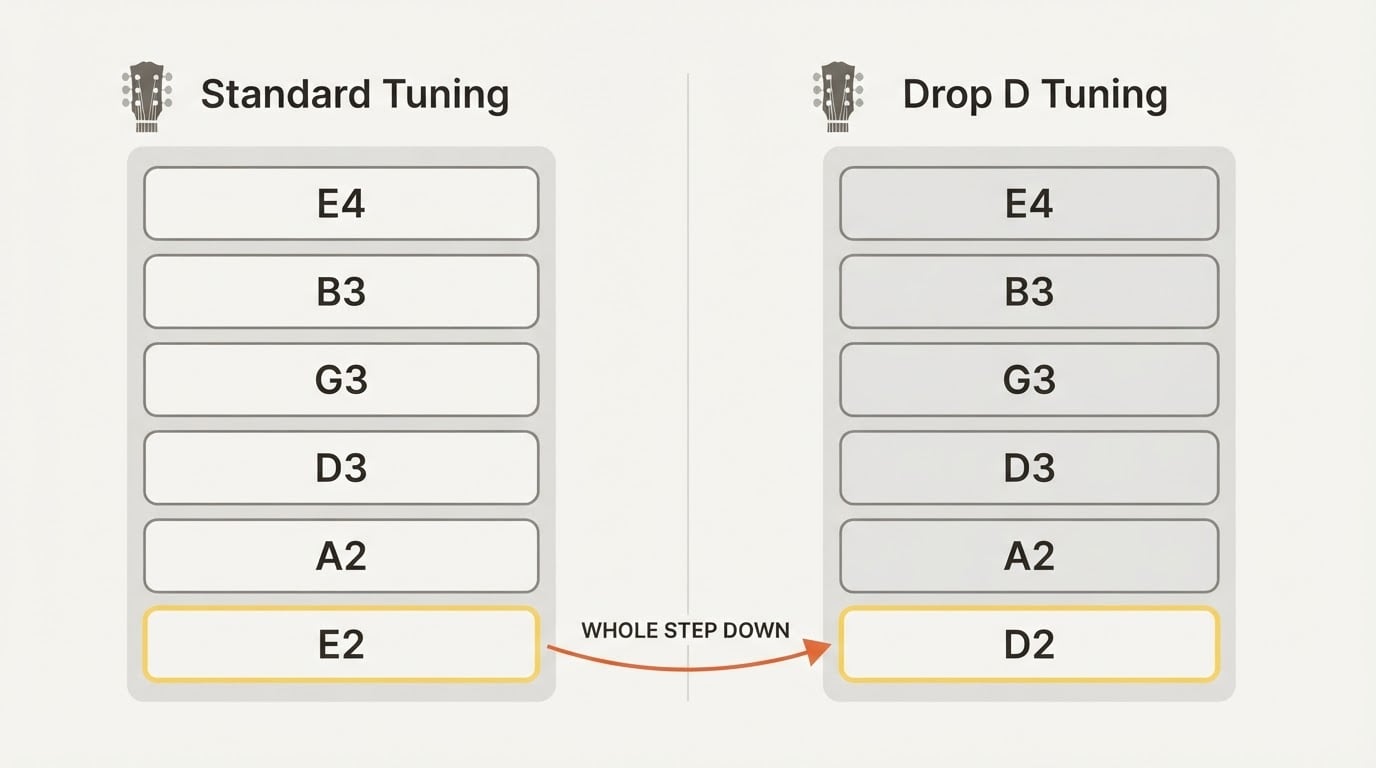
The low string is where the change is most noticeable. In standard tuning the sixth string is E, a fourth below the A string. In open D it drops a whole step to D and becomes the root of the whole tuning instead of the bottom of a stack of fourths. Three consequences follow:
- One finger barred across all six strings produces a full major chord with the root in the bass.
- The lowest note the guitar can play is now D2, so bass lines, riffs, and low chords sit on D rather than E.
- Any standard shape that touches the sixth string now points at a different note, and the third string moved a half step too, which breaks most standard grips outright.
So instead of five or six shapes per chord type, open D gives you one movable shape, the open strings for D, and a small set of exceptions.
The target notes before you play anything
String | Standard | Open D | What changes |
|---|---|---|---|
6th (lowest) | E2 | D2 | down a whole step |
5th | A2 | A2 | unchanged |
4th | D3 | D3 | unchanged |
3rd | G3 | F#3 | down a half step |
2nd | B3 | A3 | down a whole step |
1st (highest) | E4 | D4 | down a whole step |
Four strings move and two stay put, which makes open D quicker to reach than it looks. Tune the 5th and 4th strings first if they have drifted, then lower the 6th, the 1st, the 2nd, and finally the 3rd. Finish with three checks: the 5th string at the 5th fret should match the open 4th string, the 2nd string at the 5th fret should match the open 1st string, and the 3rd string at the 3rd fret should match the open 2nd string. Always approach a pitch from below, and if you overshoot, slacken past the note and creep back up rather than fighting the peg downward.
None of that has to be guesswork. GuitarTuner.io is a free browser tuner with alternate-tuning references, so you can check the target notes for Open D, D2 A2 D3 F#3 A3 D4, before you play and then tune by ear against them. Nothing to install.
Major chords: one shape plus two embellishments
Play all six strings open and you have D major: D, A, D, F#, A, D.
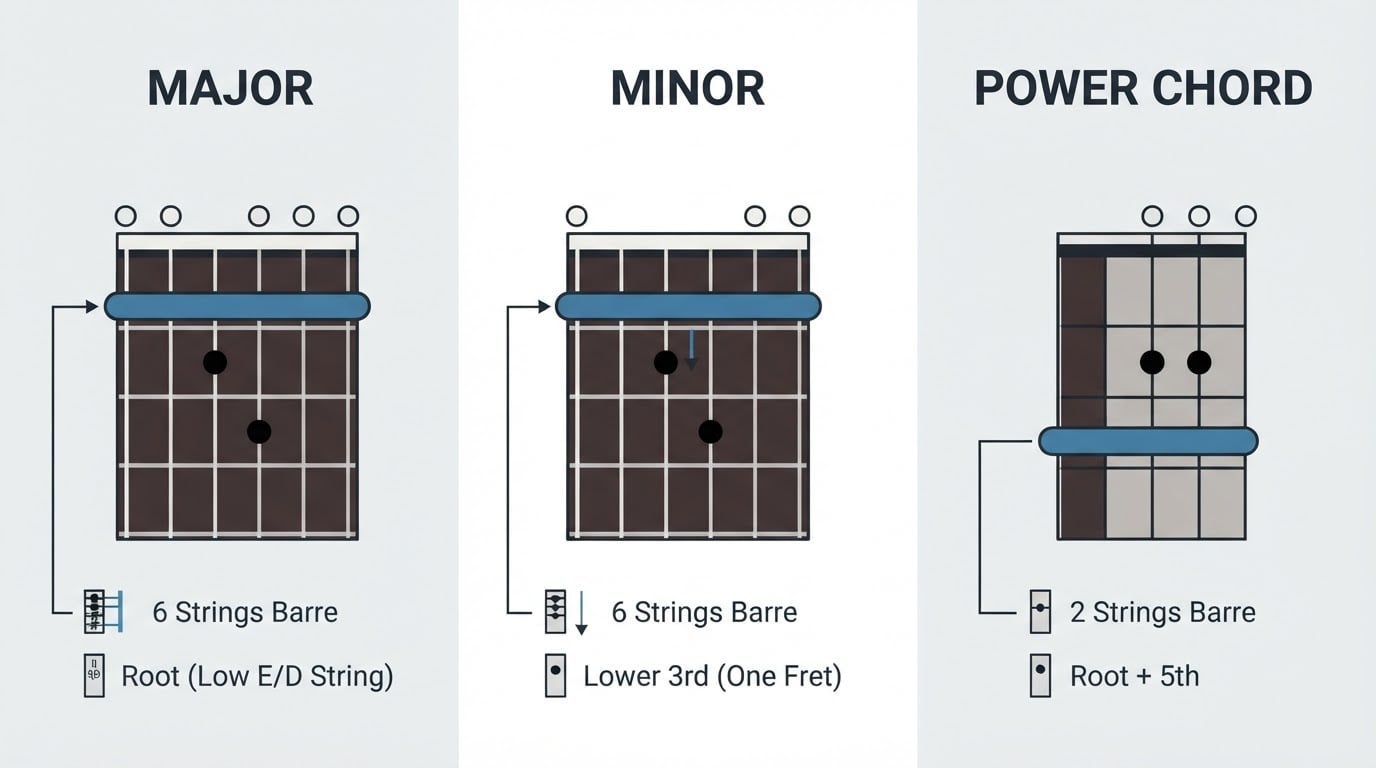
For anything else, bar your first finger across all six strings. Every stop is a major chord rooted on the note under the sixth string: fret 2 is E major, fret 3 is F major, fret 5 is G major, fret 7 is A major, fret 10 is C major, and fret 12 is D again.
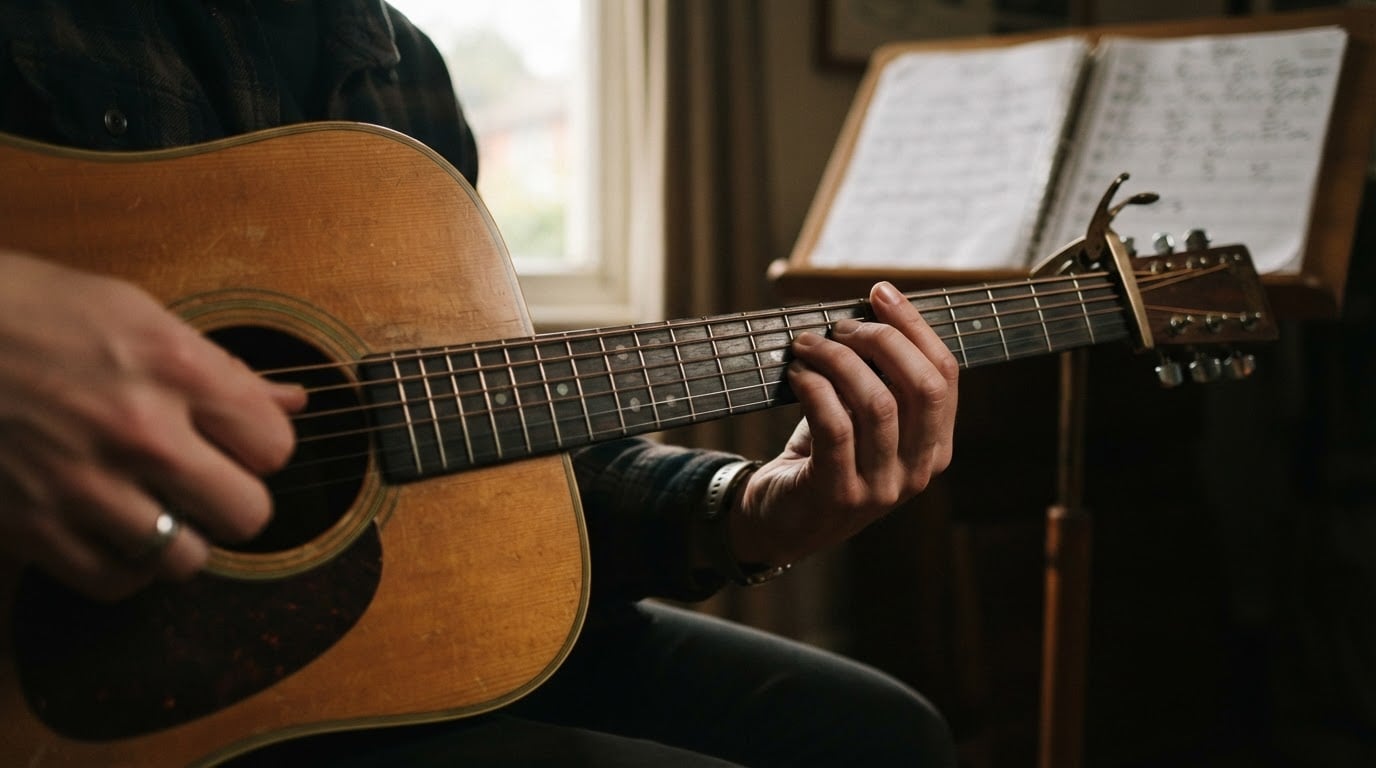
If a full six-string barre is too heavy at first, bar only the top three strings at the same fret. Those strings are tuned to the third, fifth, and root of the chord, so the short barre still gives you a complete major triad. The trade-off is voicing rather than content: the third of the chord ends up in the bass, which sounds lighter and less dense than the six-string barre. Fret 2 gives E major, fret 5 gives G major, and fret 7 gives A major.
Single-finger moves cover most of the color you will want while strumming. Fret the 3rd string at the 1st fret and D becomes Dsus4, because G replaces the F#. Fret the 1st string at the 2nd fret and you add an E on top of the open chord, which gives a Dadd9 voicing; a strict Dsus2 would need the open F# on the 3rd string to stop sounding. Fret the 6th string at the 4th fret for D/F# when you want the third of the chord in the bass.
Minor chords: shift the barre back one fret
The open 3rd string is F#, the major third of D, and you cannot lower it while you play, so minor chords flatten that note by moving the shape rather than the string: barre all six strings at fret N, then play the 3rd string one fret lower, at fret N minus 1. Everything else stays where the barre put it, and the note you gain is the minor third of the chord rooted at the barre.
- Barre 2, 3rd string at 1: E minor
- Barre 3, 3rd string at 2: F minor
- Barre 4, 3rd string at 3: F# minor
- Barre 5, 3rd string at 4: G minor
- Barre 7, 3rd string at 6: A minor
- Barre 9, 3rd string at 8: B minor
D minor is the exception, because there is no fret below the open third string. Build it from the D strings instead: leave the 6th, 5th, and 4th strings open, fret the 1st string at the 3rd fret to get the F, and leave the 3rd string out so its F# does not fight the chord. The open 2nd string supplies an A, so the notes are D, A, D, A, F, which is root, fifth, and minor third. The same trick returns at the 12th fret, where a barre with the 3rd string at fret 11 gives D minor again.
A shape worth keeping by accident: barre the top three strings at the 3rd fret over the open bass and you get Dm7, with A, C, and F ringing over the open D and A strings.
The limitation is worth knowing early, because it shapes what open D is good at: keys that need minor chords on the open strings take more care than the majors, which is why the D, G, A, and B minor family comes first.
For a low B minor with no barre at all, fret the 5th string at the 2nd fret and let the 6th, 4th, and 3rd strings ring open. The notes are D, B, D, and F#, which is B minor with its third in the bass: one finger, four strings, and it sits right under the melody.
Power chords: two bass strings, same fret
The 6th and 5th strings are tuned a fifth apart, so one finger laid across both at the same fret gives a fifth chord with the root underneath: fret 2 is E5, fret 5 is G5, fret 7 is A5, and the open pair is already D5. Moving two fingers around the neck gives you a riff vocabulary without any new grips.
The same pair works on the 5th and 4th strings, where the fifth sits below the root instead of above it. It is the same interval flipped, and it carries a riff just as well.
Three progressions worth learning first
D, G, A is the I-IV-V in D, played with the open strings and two barres: strum open for D, barre at the 5th fret for G, barre at the 7th fret for A. Both upper chords use the same shape, so your hand moves without changing grip and the open strings keep ringing between changes.
D, B minor, G, A keeps two of those shapes and drops the one-finger B minor in the middle, so the bass barely leaves the low D area.
D, Dsus4, D is the simplest arrangement trick in the tuning: hold the open chord, add the 3rd string at the 1st fret, lift, and repeat. The same move over the barre at the 5th fret pushes into G.
Slide playing is where the tuning pays off most. A straight bar across the strings is a major chord at every fret, and the low D string gives the bass notes something a slide can lean on. Open D and open G are the two tunings most slide players keep a guitar set up for.
Mistakes that cost beginners the most
- Carrying standard shapes over. A standard barre shape is not a major chord here. Learn the shapes from the tuning instead of translating the old ones.
- Letting the open third string ring in minor chords. F# is the major third of D, so it has to be fretted or skipped whenever the chord turns minor.
- Assuming the sixth string is still E. It is D, two frets below what your ear expects, which throws off every reference note you learned on the low string.
- Turning pegs the wrong way. Four strings go down and two stay put in open D, so check the target note before you decide which direction to turn.
- Ignoring settling. Three strings drop a whole step, so check the tuning again after a few minutes of playing, especially with a fresh set of strings.
- Flattening a finger across the third string in a minor shape. That string usually sits one fret back from the barre, and covering it turns the minor back into a major.
- Barring harder instead of repositioning. A buzzing barre is nearly always a finger position problem, usually a finger sitting too far behind the fret.
FAQ
Is open D the same as drop D? No. Drop D lowers only the sixth string and leaves the other five in standard tuning, so you get a low D for power chords and keep standard shapes. Open D changes four strings and turns the whole instrument into a D major chord.
Do I need a capo? No, but it works well with open D. A capo at the 2nd fret turns the tuning into open E, and a capo at the 4th fret turns it into open F#, with the same shapes under your fingers.
Can I play every chord in open D? Every chord exists somewhere on the neck, but not every chord has an easy open shape. The movable major and minor shapes cover most keys, and the chords closest to D, G, A, B minor, E minor, and F# minor, fall under the fingers first.
How do I verify the guitar is really in open D? Strum all six strings and listen for a clean major chord with no wobble between strings, then check two matches: the 5th string at the 5th fret against the open 4th string, and the 2nd string at the 5th fret against the open 1st string.
Will the strings feel too loose? A whole step down on three strings changes the feel of the guitar more than the pitch does. If the low D sounds flabby, a slightly heavier sixth string helps, but the change is most noticeable right after you tune and settles as you play.