What Makes a Song Easy on Guitar
"Easy" is not a genre. It is a set of conditions you can check before you commit to learning a song, and a short checklist you can run on any chart in about a minute.
How many chords it uses. Two to four shapes is a beginner song. Six chords, a key change, or several passing chords will take longer even when every shape is simple.
How often the chords change. A song that holds one chord for a full bar gives your fingers time to move. A song that changes twice per bar asks for the same motion at double speed, which is why tempo often matters more than chord count.
Which shapes are required. Em, Am, C, G, D, A, and E sit comfortably under beginner fingers. Barre chords such as F, Bm, and F#m are the usual blockers, but many songs can be played in a friendlier key or with a capo that moves the shapes back into open territory.
What the right hand does. A steady downstrum on the beat is much easier than a sixteenth-note strum or a fingerpicking pattern. Start with the simplest rhythm the song allows and add detail later.
Two more signals are worth checking. A repeating loop — the same two or four bars over and over — is easier than a song with new material in every section. A song you can hum from memory is also easier to learn, because you already know when the changes are coming.
The Chords That Cover Most Easy Songs
You do not need a chord encyclopedia to start. Five shapes cover a large share of beginner repertoire: Em, Am, C, G, and D. Add A, E, and Dm and most three-chord songs and slow four-chord loops are within reach, including a lot of folk, country, and campfire standards.
A sensible order to learn them in:
- Em and Am — two-finger shapes that build finger strength without much stretching.
- C and G — the anchor pair behind countless pop progressions.
- D and A — needed for songs in D and A, and for the four-chord loops further down.
- E and Dm — two shapes that appear in hundreds of songs and are easy to add once the first four are comfortable.
- F, or Fmaj7 as a substitute — the first barre-family chord. Fmaj7 often works when a chart calls for F and the full barre is not ready.
Practice shapes as changes, not as poses. Pick two chords and switch between them for one minute, counting clean changes. Move all your fingers at once rather than one at a time, keep fingertips close behind the fret, and press just hard enough for a clear note. If a string buzzes, check whether the finger has drifted into the fret rather than sitting behind it.
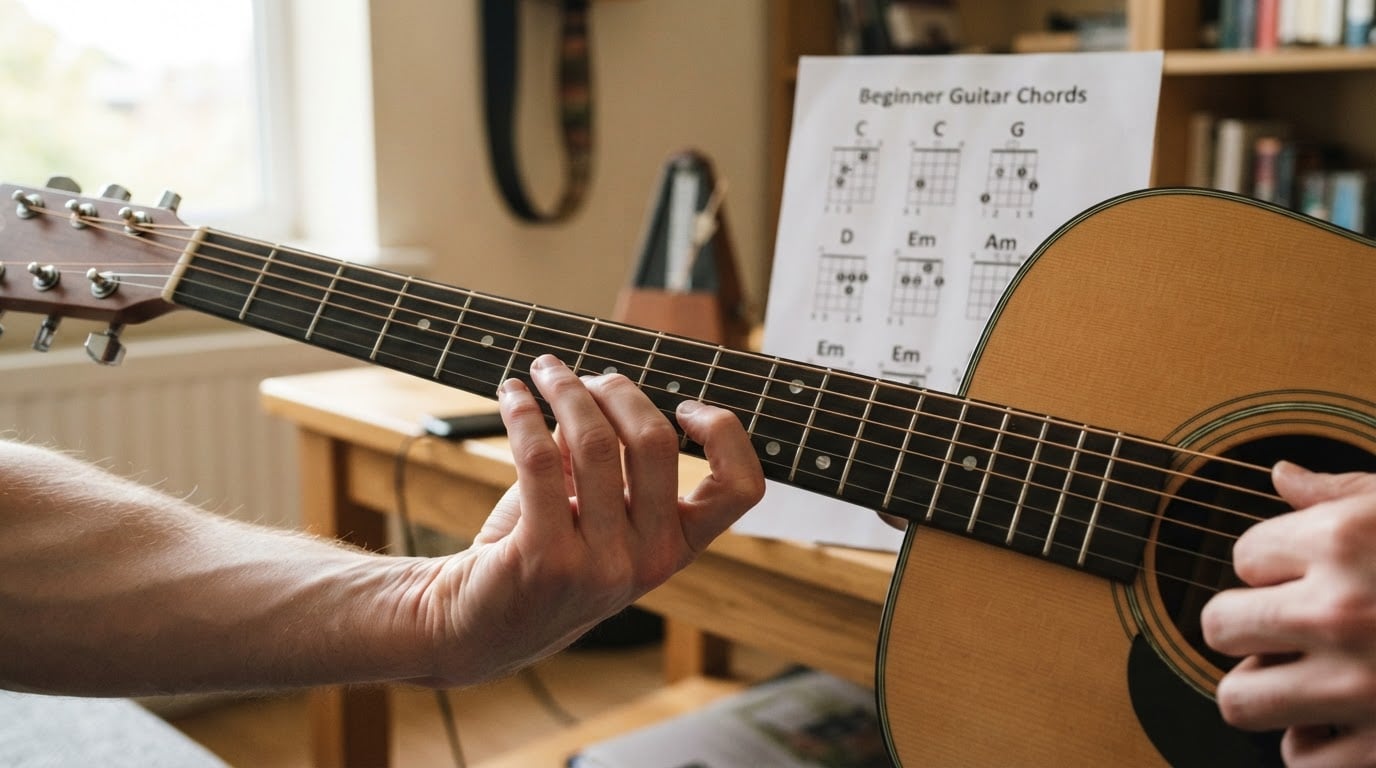
One shortcut for later: many songs are written in keys that need a barre chord, but the same song can often be played with open shapes by putting a capo where the chart suggests. The chord names change; the shapes do not.
How to Find Songs That Match the Chords You Know
A search for beginner guitar songs returns lists built for very different skill levels. Filter each list against the chords you can already play.
- Search by shapes, not just difficulty. Queries such as "songs with G C D" or "three chord guitar songs" surface charts that use only the shapes you know.
- Read the key and the capo note. Most charts state the key and whether a capo is needed. A chart marked "capo 2" is not harder — it usually means easier shapes.
- Scan for barres before you commit. If the chart contains F, Bm, or F#m, decide whether you can substitute a simpler voicing or pick a different song for now.
- Look for the loop. A chart that repeats the same four chords through verse and chorus is worth more to a beginner than a song with a new progression in every section.
- Listen once with the chart open. You will hear where the changes fall, which is faster than counting bars in your head.
If you would rather not hunt for a chart, GuitarTuner.io keeps a free browser chord reference and a metronome in the same tab, with nothing to install. Check the shape you are unsure about, set a slow click, and practice the change without leaving the page.
Easy Guitar Chords Songs to Learn First
These songs are grouped by what they ask of your hands. Chord charts and arrangements vary, so treat each chord set as a starting point and check the chart you use.
Two and three chords
- "Horse With No Name" — two shapes. Most charts use Em plus a D6/9-style shape, which makes it one of the fastest first songs on guitar.
- "Wild Thing" — A, D, E. Three chords, one riff, and a forgiving strumming pattern.
- "Three Little Birds" — A, D, E. Slow changes that leave time to look at your fingers.
- "Love Me Do" — G, C, D. A gentle introduction to changing on the beat.
- "Bad Moon Rising" — D, A, G. A good first mix of a fast strum and simple changes.
- "Sweet Home Alabama" — D, C, G. Three shapes and a riff that repeats all the way through.
Four-chord campfire songs
- "Knockin' on Heaven's Door" — G, D, Am. A slow, even progression; some charts add C.
- "Stand By Me" — G, Em, C, D. The I-vi-IV-V loop in a beginner-friendly key.
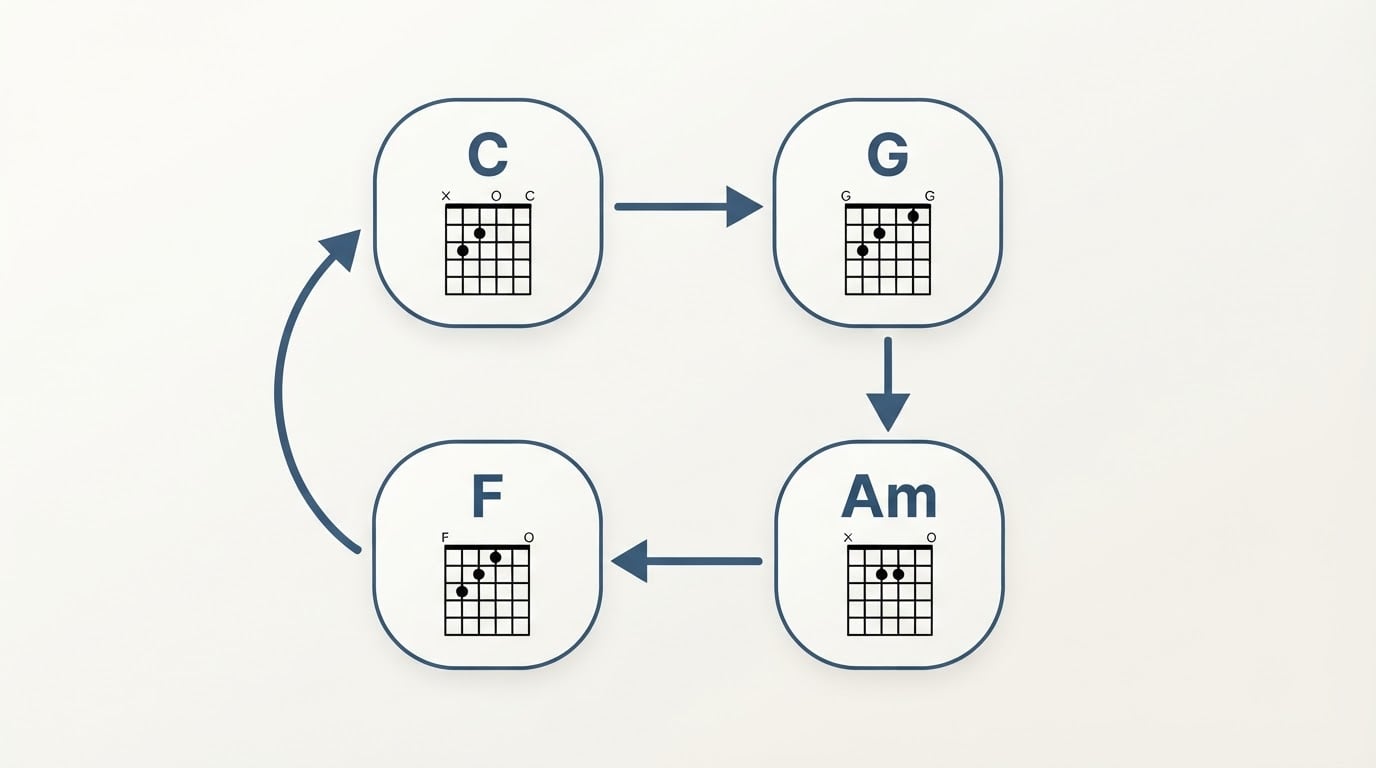
- "Let It Be" — C, G, Am, F. Use Fmaj7 while the barre is still settling in.
- "Brown Eyed Girl" — G, C, D, Em. Familiar changes at a tempo that rewards a steady strum.
- "Country Roads" — G, Em, D, C. A singalong standard with a completely repeatable progression.
- "Wagon Wheel" — G, D, Em, C. The same four shapes in a different order.
- "Last Kiss" — G, Em, C, D. A slow ballad where the changes are easy to hear.
Pop songs with a capo
- "Someone Like You" — capo 2: Em, C, G, D. The vi-IV-I-V progression in open shapes.
- "Perfect" — capo 1: G, Em, C, D. A slow song that is mostly a timing exercise.
- "Zombie" — Em, C, G, D. One progression for the whole song with a dynamic strum.
- "Free Fallin'" — capo 3: D, A, G. Three chords and a repeating pattern from start to finish.
Two things stand out in that list. The same chords keep returning — C, G, Am, and F, or G, D, Em, and C — so learning to change between those shapes cleanly makes new songs feel like variations on something you already know. And the songs that feel easiest are usually the ones with the slowest changes, not the fewest chords.
How to Practice a Song with a Metronome
A metronome turns practice into something you can measure. Set it slow, play the song, and let the click tell you whether the changes land on time.
- Start at 60-70 BPM in 4/4. Slow enough to change chords without rushing. If the song feels impossibly slow, that is the point.
- Loop two to four bars. A small section practiced cleanly beats a whole song played badly. Repeat the loop until the changes arrive on the beat without hesitation.
- Change on the click, not after it. Aim to have the new shape ready a moment before the beat, so the chord rings in time.
- Add strumming only when the changes are clean. Chords first, rhythm second.
- Raise the tempo by 5 BPM when the loop is clean twice in a row. A clean loop at a slow tempo is progress; a messy loop at a fast tempo is not.
- Recheck the loop the next day. If it falls apart at yesterday's tempo, drop back 5-10 BPM and rebuild it.
A metronome in an open browser tab works well for this: it stays visible while your chord chart is up, and you can adjust the tempo without leaving the page. A hardware metronome on the music stand does the same job. What matters is that the tempo stays steady and sits slightly slower than you would like.
Before you start, take a minute to tune. New strings and changes in room temperature pull a guitar out of tune, and practicing on an out-of-tune guitar trains your ear to accept the wrong pitch. A microphone-based browser tuner is the quickest option when you are already sitting in front of a screen.
Common Questions About Easy Guitar Songs
How many chords do I need to know to play easy songs?
Four to six open chords cover a surprising amount of repertoire. Em, Am, C, G, D, and A are enough to start; add Fmaj7 or a capo when a song asks for more.
Can I play easy songs without barre chords?
Yes. Many songs can be played with open shapes in another key, with a capo, or with a substitute voicing such as Fmaj7 for F. Barre chords are worth learning, but they do not have to block your first twenty songs.
How long does it take to learn an easy song?
A slow three-chord song is often recognizable after a few sessions of 15-20 minutes. A four-chord song with faster changes can take a week or two. Short, consistent sessions beat one long session.
Should I tune before every practice session?
Yes, especially with new strings or a change in room temperature. Tuning takes under a minute with a microphone-based browser tuner and keeps you from practicing in the wrong key.
What should I do when a song needs a chord I cannot play yet?
Substitute an easier voicing, capo into a friendlier key, or set the song aside for a few weeks. There are enough two-, three-, and four-chord songs to keep you playing while your hands catch up.