What half step down tuning is
Half step down tuning is standard tuning with all six strings lowered by exactly one semitone, which is one fret. Low to high, the strings read Eb Ab Db Gb Bb Eb.
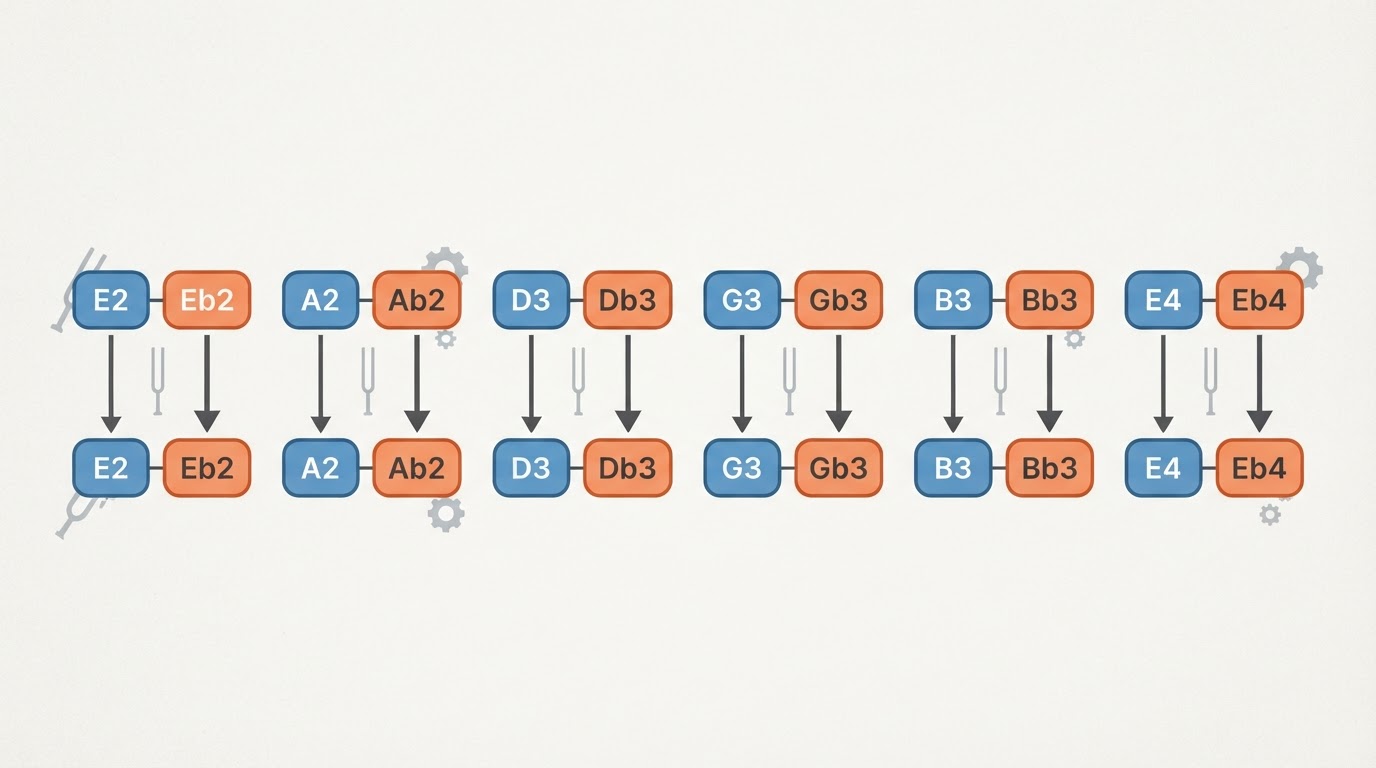
You will also see it called Eb standard, E-flat tuning, or D# tuning. Those names all point at the same six notes, so use whichever spelling your tuner shows and ignore the rest.
The fretboard moves with the strings. Every shape you already know still works, it simply sounds a half step lower. That is most of the appeal: no new chord shapes to learn, a different key coming out of the same guitar.
If your tuner displays note names instead of letters, aim for these targets. The frequencies use the same 440 Hz reference as most apps, pedals, and clip-on tuners.
String | Standard tuning | Half step down | Target frequency |
|---|---|---|---|
6th (low E) | E2 | Eb2 / D#2 | 77.78 Hz |
5th (A) | A2 | Ab2 / G#2 | 103.83 Hz |
4th (D) | D3 | Db3 / C#3 | 138.59 Hz |
3rd (G) | G3 | Gb3 / F#3 | 185.00 Hz |
2nd (B) | B3 | Bb3 / A#3 | 233.08 Hz |
1st (high E) | E4 | Eb4 / D#4 | 311.13 Hz |
A chromatic tuner treats Eb2 and D#2 as the same pitch, so either label is correct. What matters is that every string lands one semitone below where it started, not two.
Why players tune down a half step
Bending gets easier. A lower tuning means less tension on each string, so a whole-step bend takes less finger strength and vibrato feels looser. Players who bend constantly, which is most of the blues vocabulary, notice the difference immediately.
The tone gets darker. Dropping every string flattens the whole instrument, and the same riff lands heavier and rounder than it does in standard tuning. It is one reason half step down is common in hard rock and metal-adjacent styles, where the point is weight rather than brightness.
Singers get a lower key. A vocalist who can reach the top of a song in standard tuning but sounds strained can keep every familiar shape and sing in Eb instead. This is the reason half step down shows up so often on records built around a specific voice.
One semitone looks like almost nothing on paper. Under the fingers and under a voice it is the difference between a song that fits and a song you have to fight, which is why Eb tuning has stayed in use for decades.
How to tune to half step down with a tuner
Any chromatic tuner works: a clip-on, a pedal, a phone app, or a tuner page in a browser. Work through the strings in this order.
- Check the guitar is roughly in standard tuning first. Starting from a guitar that is already close to pitch keeps you from guessing which direction to turn.
- Set the tuner to chromatic mode, or pick the Eb or Half Step Down preset if it has one.
- Start with the 6th string: pluck it, let the note ring, and turn the tuning peg down until the display reads Eb2 or D#2 instead of E2.
- Move up one string at a time: 5th to Ab2, 4th to Db3, 3rd to Gb3, 2nd to Bb3, 1st to Eb4.
- Go around all six strings once more. The first string you loosen changes the pull on the neck slightly, so the others drift by a few cents while you work.
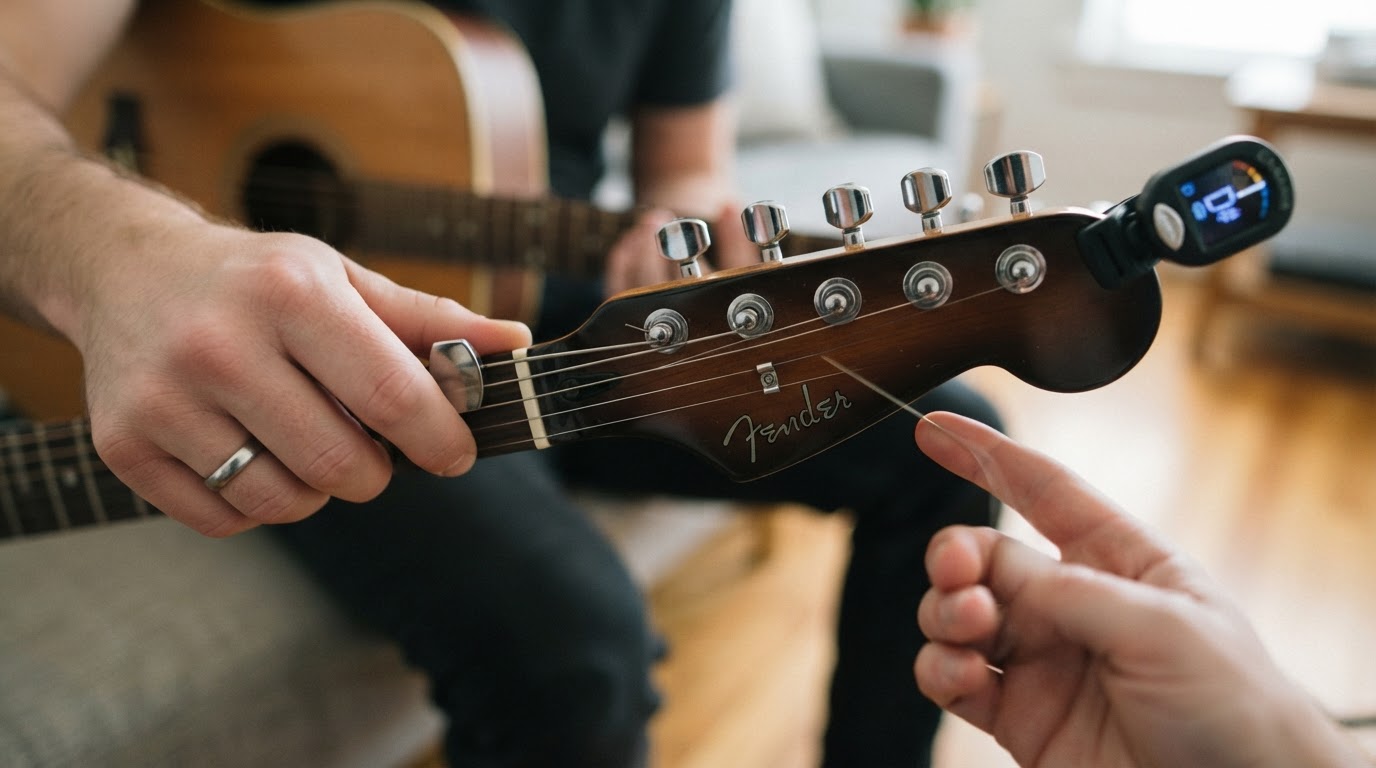
Turn the peg in small amounts and give the display a second to settle before you stop. If you go past the note and land on D on the 6th string, you have dropped a whole step, so tighten back up. A string that arrives at pitch from below tends to hold better than one you loosened into place.
Counting semitones in your head is not required. GuitarTuner.io keeps a free browser reference for alternate and drop tunings, and its guide library covers alternate tunings, tuning stability, and string maintenance, with every article tagged by difficulty and reading time. That reference is the quicker way to confirm the notes you are aiming for, and everything below works the same way whether you open it or not.
How to reach half step down without a tuner
By ear, the whole job is relative except for one note: the lowest string needs an outside reference, because nothing else on a standard-tuned guitar produces that exact Eb2.
For the 6th string, use one of these:
- A piano or keyboard: play the E that matches your open 6th string, then play the Eb just below it and lower the guitar string until the two agree.
- A recording in Eb tuning: play the track, hit the low string, and flatten it until the wobble between the two disappears. Matching a record is easier than tuning in silence, because you get a steady reference note to lean on.
- A second device with a tone generator or tuner app.
- No reference at all: play the 4th string at the first fret, which sounds Eb3, and lower the 6th string until the two notes are clearly the same letter an octave apart. This one takes a trained ear, so treat it as a rough fallback.
Once the 6th string sits at Eb, the rest of the tuning is ordinary relative tuning. Play the two strings together and match them:
- 5th string to the 6th string's 5th fret, giving Ab.
- 4th string to the 5th string's 5th fret, giving Db.
- 3rd string to the 4th string's 5th fret, giving Gb.
- 2nd string to the 3rd string's 4th fret, giving Bb. This is the one gap that is not five frets, exactly as in standard tuning.
- 1st string to the 2nd string's 5th fret, giving Eb.
Play each pair as a chord and listen for the slow throb that means two notes are almost but not quite the same pitch. When the throb stops, the pair is locked.
How to check that you are in tune
Pluck a string and let it ring for a few seconds rather than watching the first instant. The reading right after the attack is often sharp, and the pitch you care about is the one that settles.
Then check the relationships, not just the individual notes:
- Play the 6th string's 5th fret against the open 5th string. The two should sound as one note.
- Repeat down the set: 5th string fret 5 against the open 4th, 4th against the open 3rd, 3rd fret 4 against the open 2nd, 2nd fret 5 against the open 1st.
- Play an Em chord shape. In half step down it sounds as Eb minor. If it sounds sour or one string rings against the others, that string is off.
- Compare the 12th fret harmonic with the 12th fret fretted note on each string. If the fretted note is clearly sharp, the string is in tune open but the guitar's setup needs attention.
Tune, then play for a minute, then check again. Bends and hard strumming pull slack through the nut and around the tuning posts, so the first check after a fresh tune is rarely the last one.
Mistakes that cost you time
Dropping a whole step by mistake
The target on the 6th string is Eb2, one semitone below E2. If the tuner lands on D, you have gone two semitones down and the entire guitar is wrong, even though every string is still in tune with itself.
Starting from a guitar that is already out
Lowering an out-of-tune guitar spreads the error across all six strings. Get close to standard first, then make the single downward adjustment on each string.
Turning the peg the wrong way
Pegs are geared for small changes, and a half step is a small change. If you cannot hear movement after a quarter turn, you are probably turning the wrong direction. Check the string's pitch before you keep going.
Fighting the slack feel
Strings tuned down a half step sit at lower tension, which is the point, but they also feel looser under the pick and can rattle if the action is very low. If you plan to stay in Eb, a slightly heavier gauge and a setup check will bring the feel back toward standard.
Forgetting a floating bridge
On a guitar with a floating tremolo, slackening six strings lets the bridge pull forward and takes the others with it. Expect two or three passes before all six strings hold, and do not adjust the springs until you have settled on the tuning you want to keep.
Playing standard-tuning songs in Eb without a capo
Every shape sounds a half step lower, so a song you learned in standard tuning will come out in the wrong key. A capo at the first fret on an Eb-tuned guitar restores standard pitches and lets you keep playing the shapes you know.
Where you will hear half step down
Half step down is the sound of blues rock and hard rock singers who want a lower key with familiar shapes. Jimi Hendrix and Stevie Ray Vaughan both worked in Eb, which is part of why so much of that era sounds simultaneously heavier and more relaxed than standard-tuned records from the same years. In hard rock, Guns N' Roses recorded "Sweet Child o' Mine" a half step down.
You will also run into it in three practical situations:
- Playing along with a record that sits in Eb, where transposing every shape by hand is far more work than retuning.
- Singing a song that is a step too high, where dropping a half step can be enough to make the top note comfortable.
- Playing with a horn player or keyboard player whose comfortable key is Eb or Bb rather than E.
FAQ
Is half step down tuning the same as Eb tuning?
Yes. Eb tuning, E-flat standard, D# tuning, and half step down all describe the same six notes: Eb Ab Db Gb Bb Eb from low to high.
What are the notes in half step down tuning?
From the 6th string to the 1st, they are Eb2, Ab2, Db3, Gb3, Bb3, and Eb4. Written another way, that is D#2, G#2, C#3, F#3, A#3, D#4.
Is half step down the same as drop D?
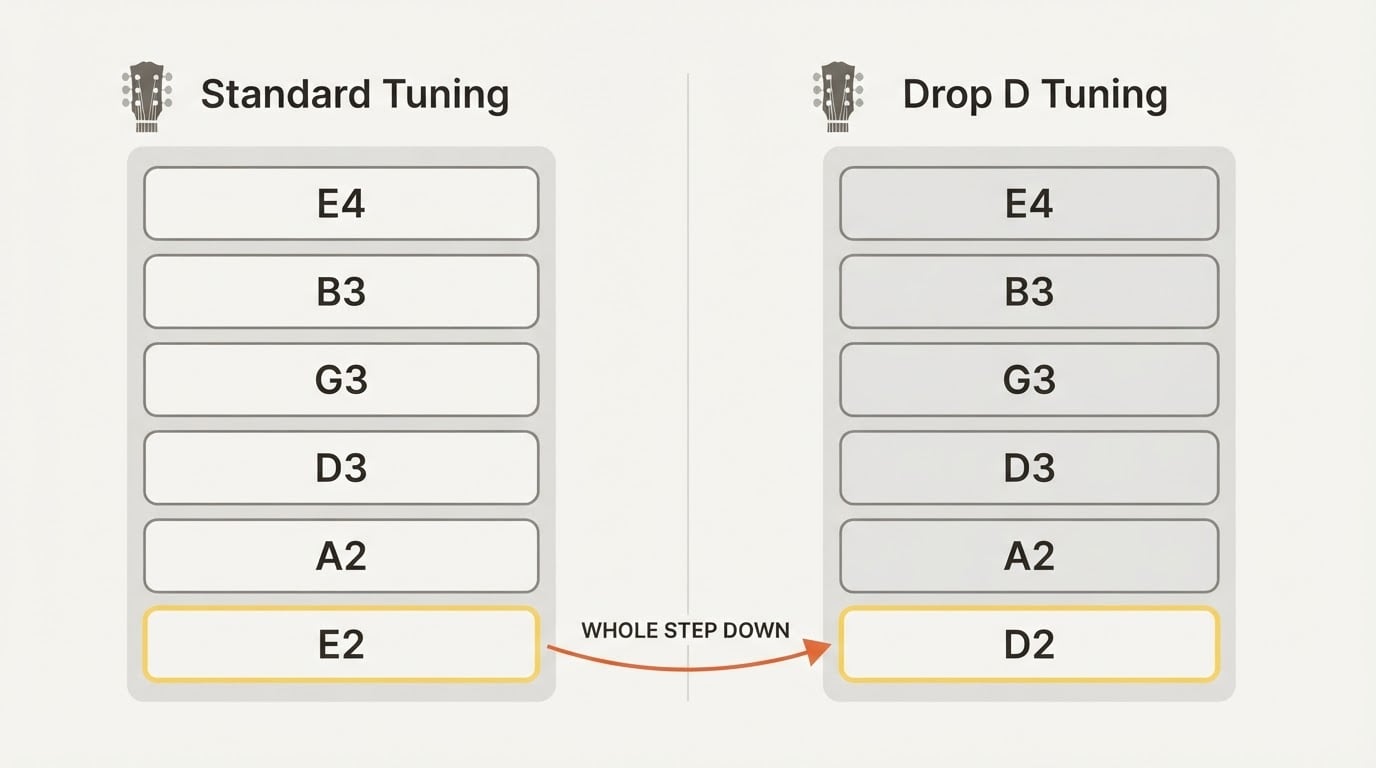
No. Drop D lowers only the 6th string, and it lowers it a whole step from E to D. Half step down moves all six strings, each by a single semitone.
Do I need heavier strings to tune down a half step?
Not to try it. The strings will feel slacker than you are used to, and that looseness is part of the sound. If Eb becomes your main tuning, a heavier gauge restores some of the tension and makes bends and picks feel closer to standard.
Can a capo put me back in standard tuning?
A capo raises pitch, so it cannot tune a guitar down. Placed at the first fret of an Eb-tuned guitar, it brings the sounding pitches back to standard tuning, which is useful when you want to play along with a standard-tuning lesson or track without retuning.